Demo sandbox. Try anything: add, change, delete. Nothing here reaches a real person, and it all resets overnight.

urShelter

Run the shelter. Not the software.

Intake, kennels, census, daily care, medical, placement and follow-up — over one animal record that the animal keeps for life, and that travels with it when it leaves you.

Already in our directory? Claim your existing listing instead — that keeps the record and its history, rather than creating a second one.

One animal, one history

An animal arrives as a stray, is fostered, is adopted, and is seen by a vet four years later. Most systems hand that animal a new record at every step. This one does not.

The animal is the record

Intake, care, medical events, custody changes and placement all attach to the same animal — so the history a new steward receives is the history you actually built.

Custody is explicit

Who holds this animal, on whose authority, since when. Foster placements, adoptions and transfers each move custody rather than copying the animal somewhere new.

It survives you

When an animal is adopted, its record goes with it. The adopter is not handed a printout — they inherit the record, and the vet they choose can read the parts they are entitled to.

What your team works in

Built and in use today.

Intake

Stray, surrender, transfer, seizure and emergency boarding, with microchip lookup at the point of entry so an animal already known to the ecosystem is recognised rather than duplicated.

Census and kennel board

Who is in care, where they are, and what is free — across runs, isolation, nursery and foster.

Daily care

A care board your staff can work from a phone, with routine events recorded as they happen rather than reconstructed at end of shift.

Placement

Adoptions, contracts, follow-ups and fosters — including the 30/90/365 continuity checks after the animal goes home.

People

Staff, volunteers and hours, with roles that mean something at your organization rather than everywhere at once.

Health and safety

Outbreak response and the veterinary practices you work with, connected to the animals rather than kept in a separate list.

On your team’s phones

Live screens from a demonstration shelter, captured on a phone. Each one is a feature your staff can use today.

My work

One list per person of what to do next, ordered by the role they hold at your shelter.
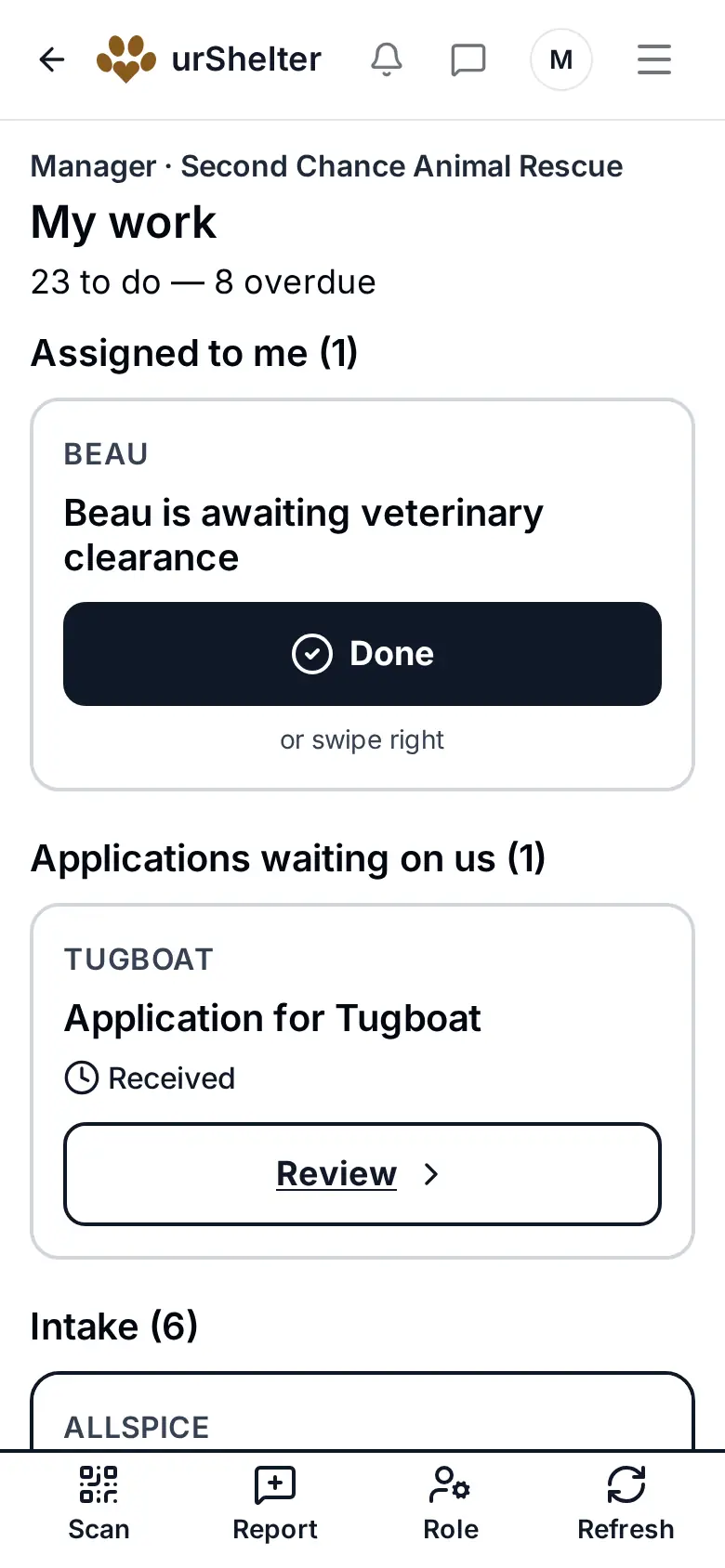
My work on a phone for a shelter manager: 23 to do, a task for Beau and an application for Tugboat to review.
Manager: tasks assigned to me and applications waiting on the shelter.
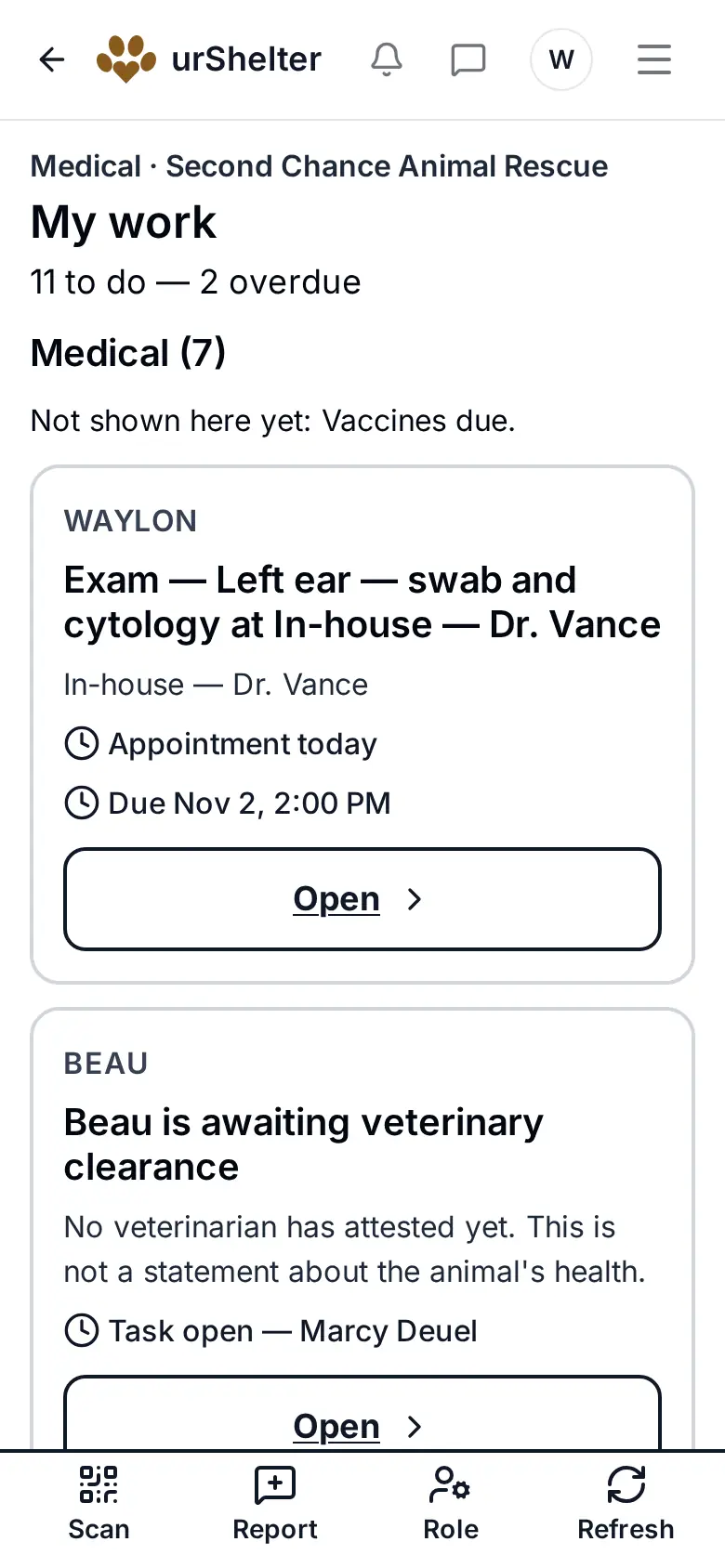
My work for a veterinary technician: an ear exam for Waylon today and Beau awaiting veterinary clearance.
Medical team: today’s appointments and animals awaiting veterinary clearance.
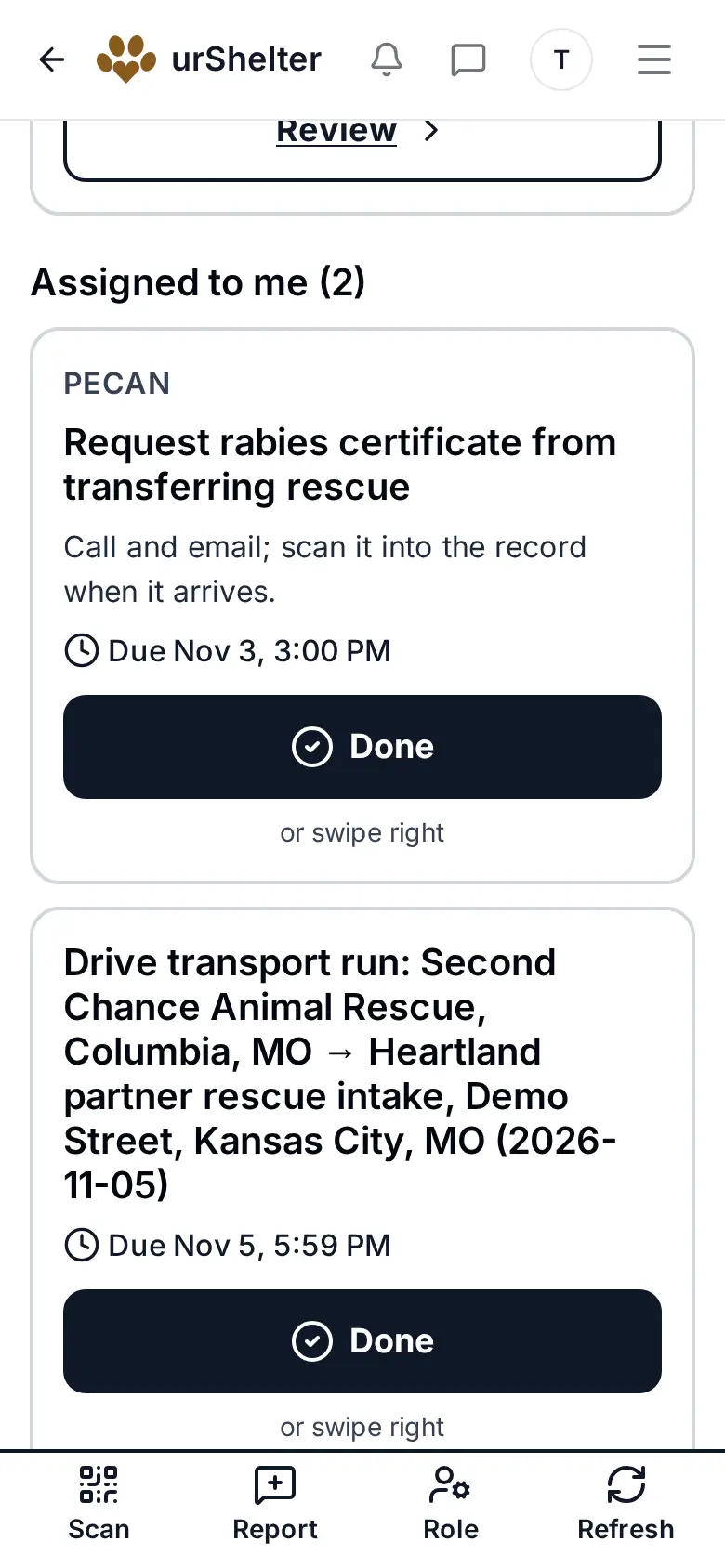
My work showing tasks assigned to a staff member, including driving a transport run to Kansas City on November 5.
Driver: the transport run assigned to them, with its date.
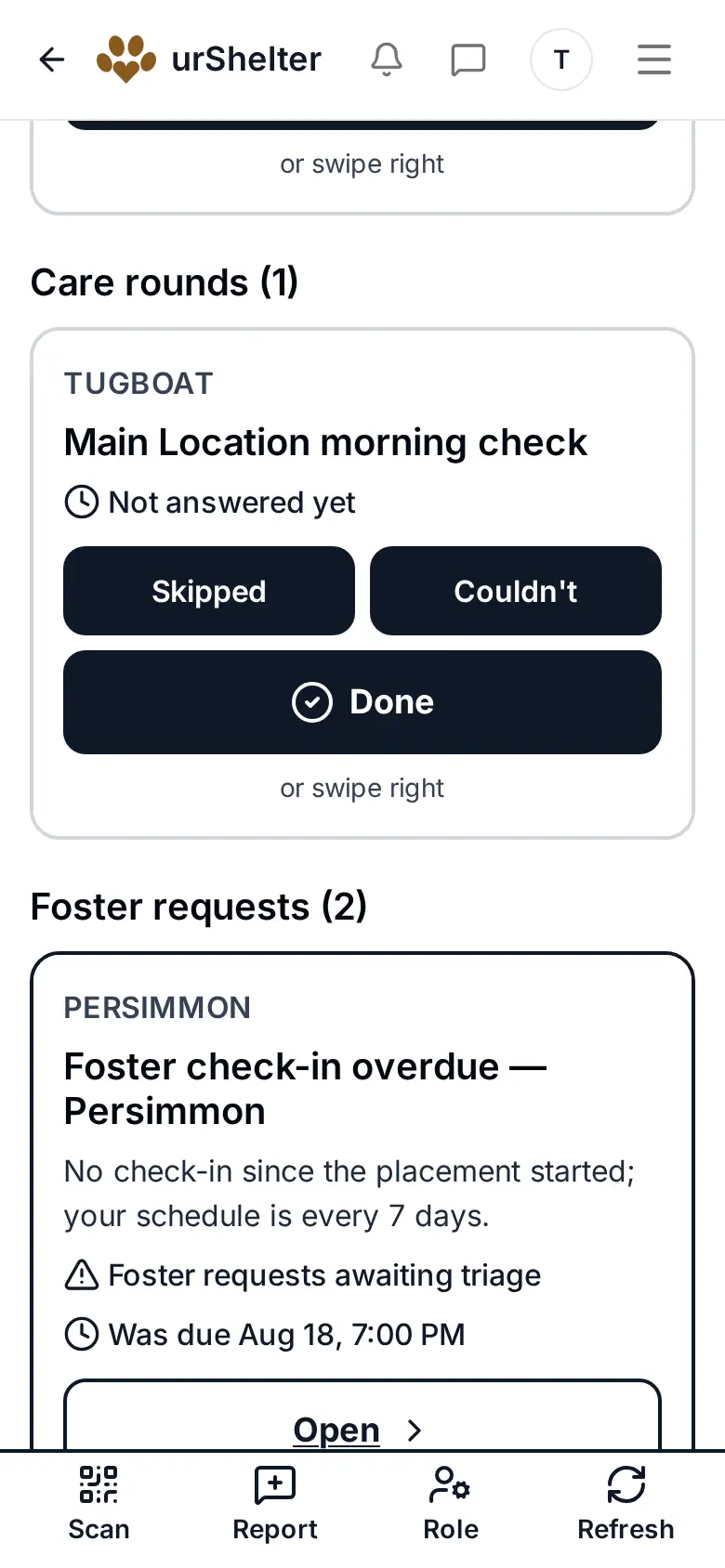
My work showing a care-rounds check for Tugboat with Done, Skipped and Couldn’t buttons, and foster requests below.
Care rounds: answer each check with Done, Skipped or Couldn’t.
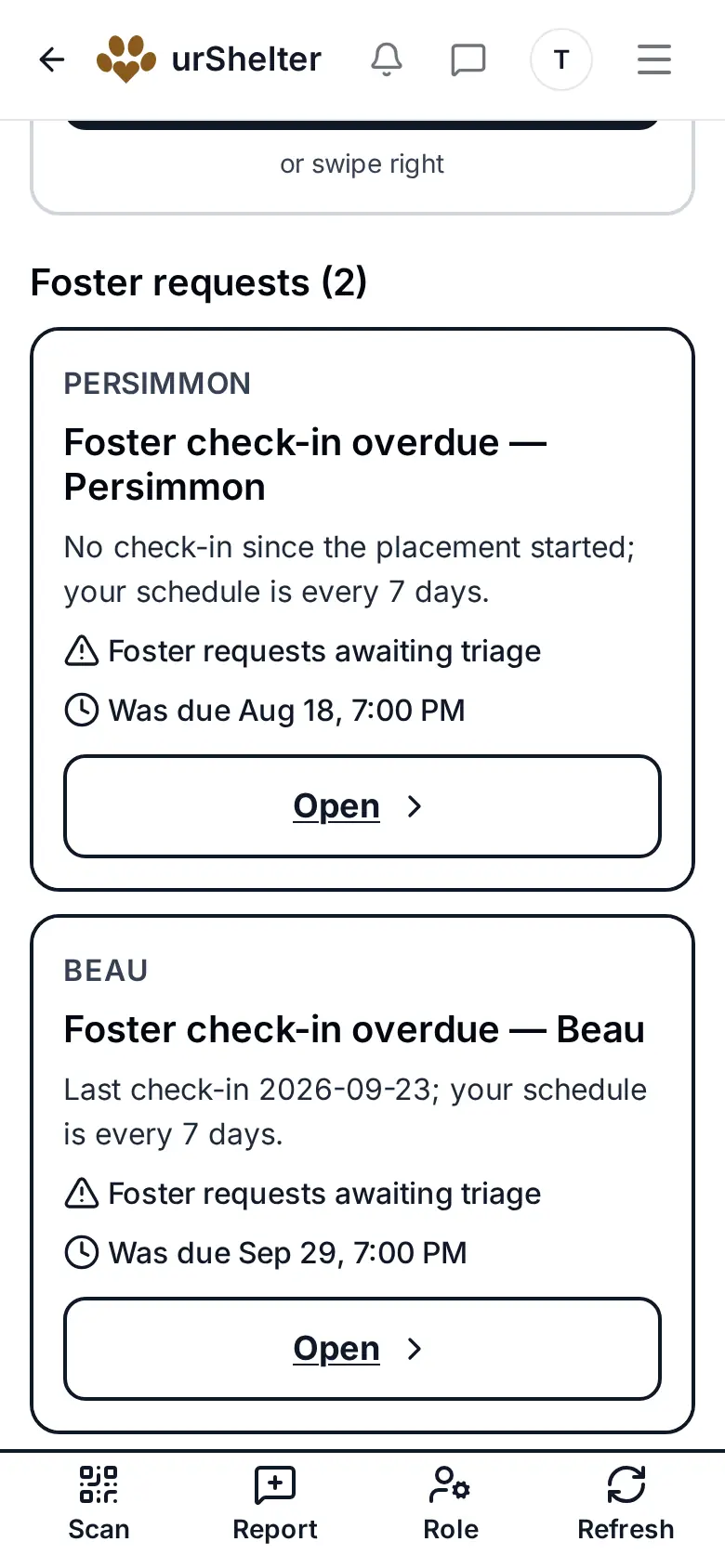
My work listing two overdue foster check-ins, for Persimmon and Beau, against a seven-day schedule.
Foster coordination: overdue foster check-ins against your schedule.

Holds, stages and next action

Each animal shows its workflow stage, the holds that block adoption, and the next thing that has to happen.
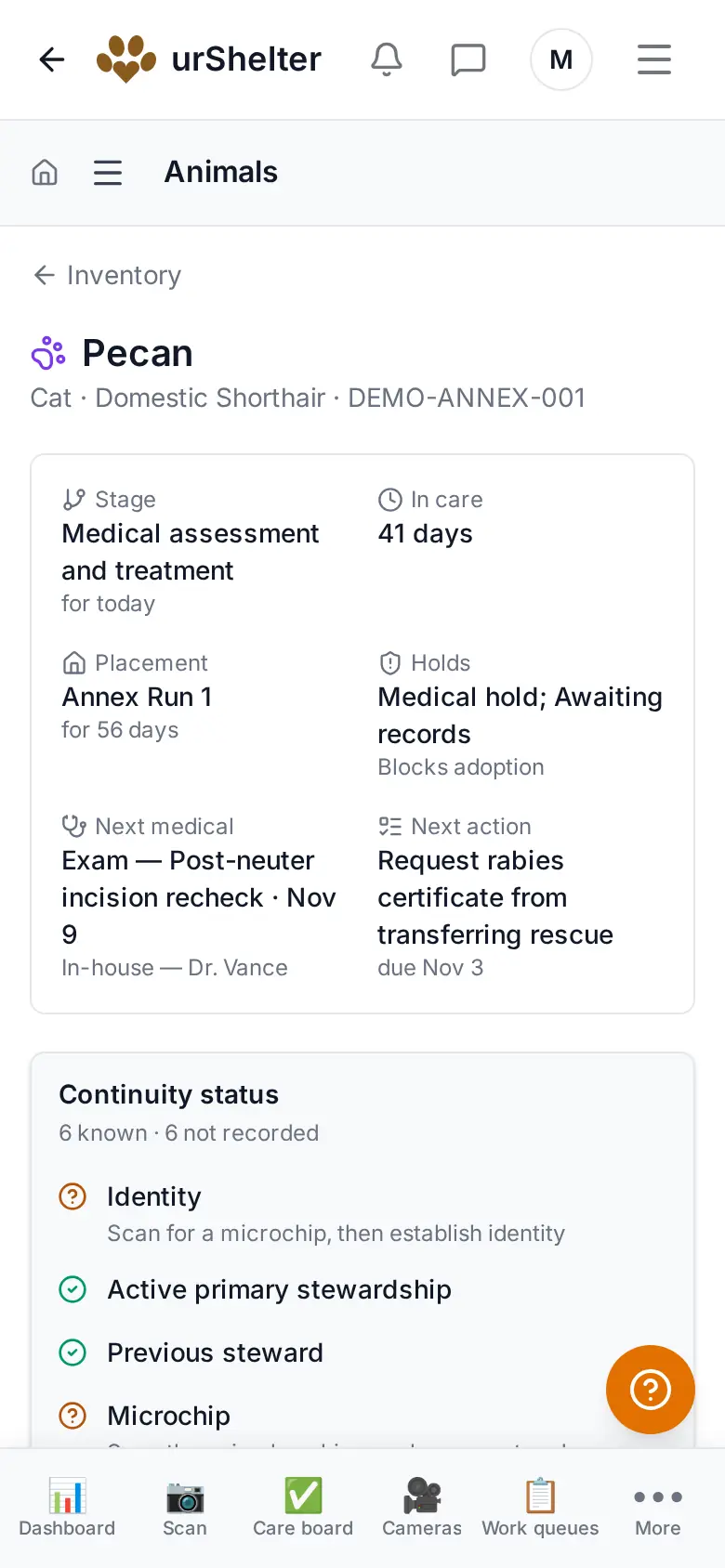
Animal record for Pecan showing stage Medical assessment, two holds blocking adoption, a recheck on November 9 and the next task.
At a glance: stage, time in care, placement, holds, next medical and next action.
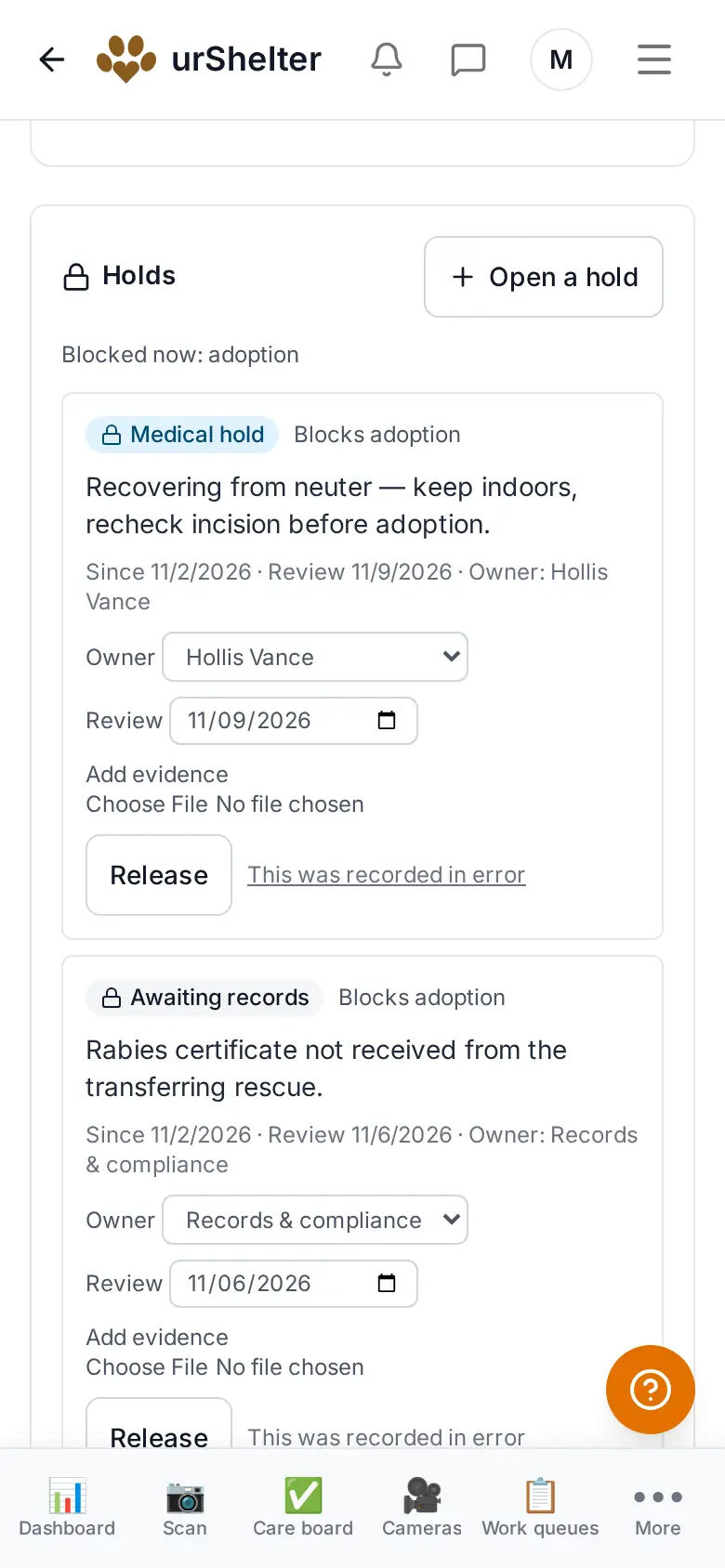
Holds panel for Pecan: a medical hold owned by Hollis Vance and an awaiting-records hold, each blocking adoption with a review date.
Holds name what they block, who owns them and when they are reviewed.
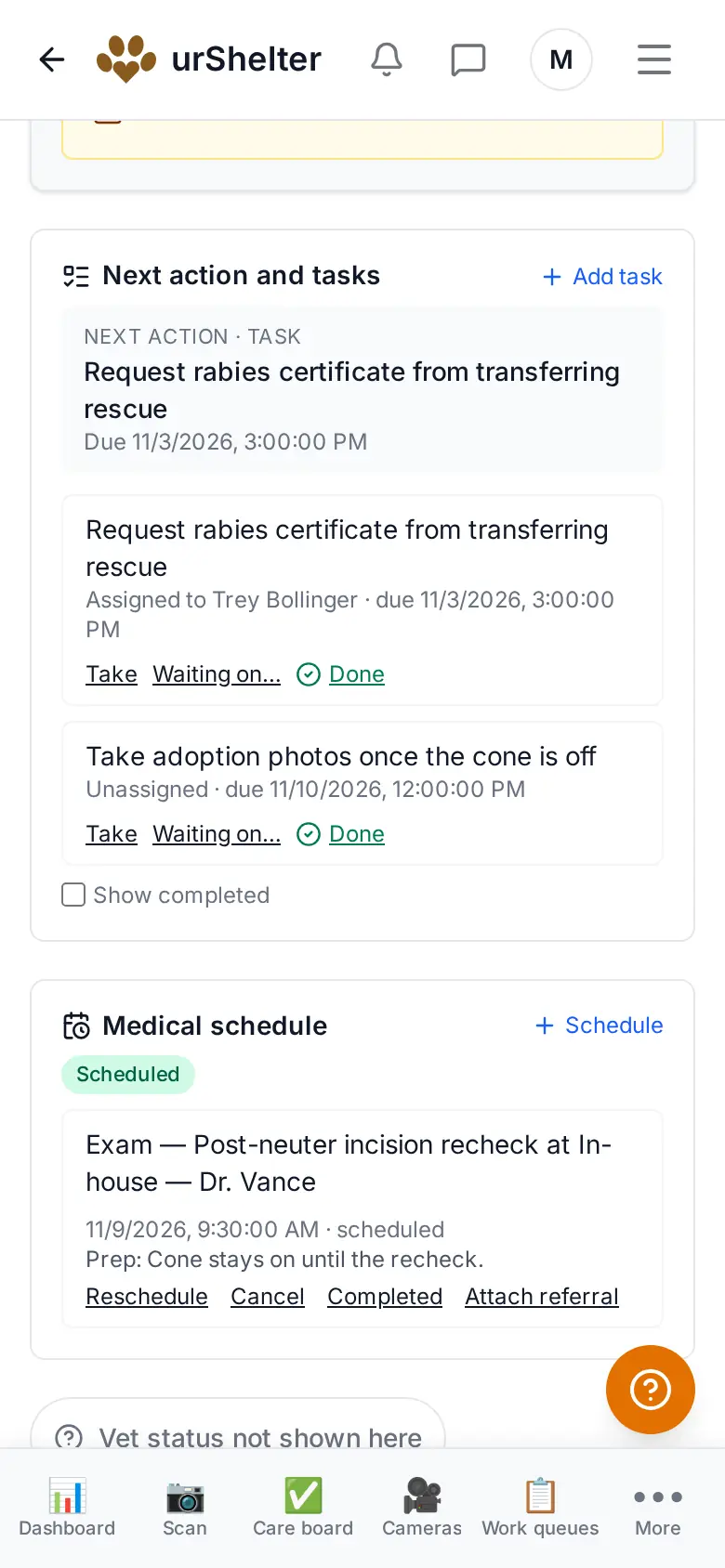
Next action and tasks for Pecan: request a rabies certificate, assigned to Trey Bollinger, and a scheduled incision recheck.
Tasks and the medical schedule on the same record.

Transport runs

Plan a run, assign drivers, and check off each animal’s paperwork before it leaves.
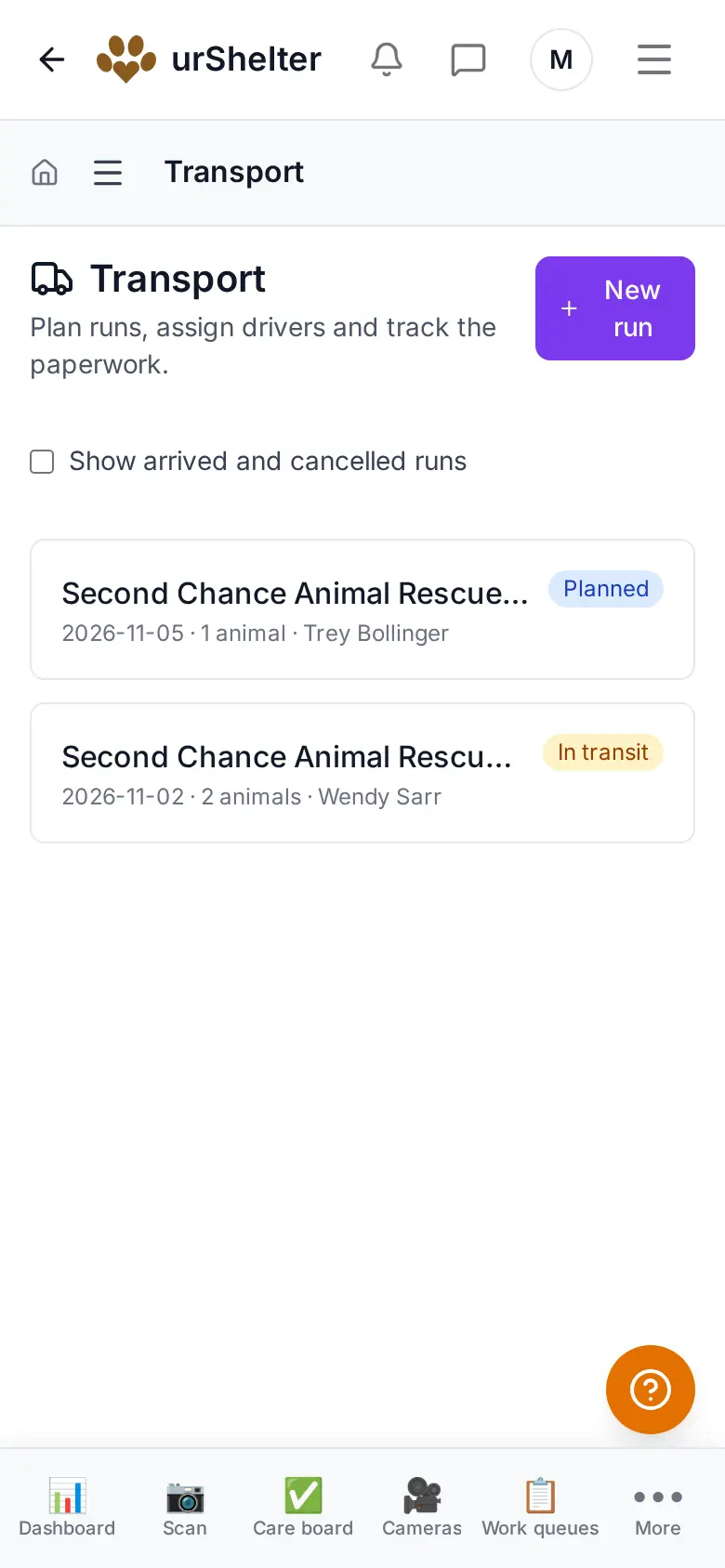
Transport list with a planned run on November 5 driven by Trey Bollinger and a run in transit driven by Wendy Sarr.
Runs with their date, animal count, driver and status.
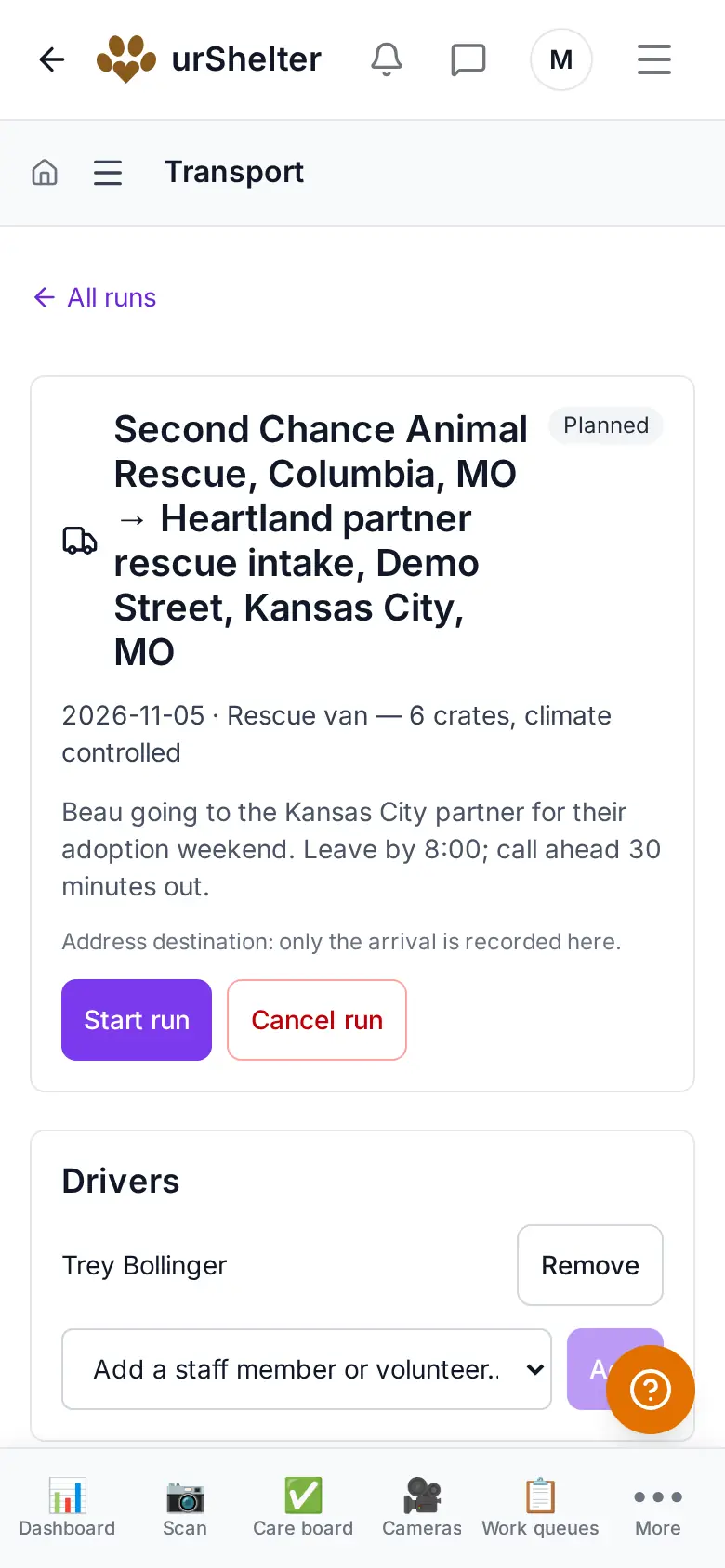
A planned transport run from Columbia to a Kansas City partner rescue, with vehicle notes and Trey Bollinger as driver.
A run: route, vehicle, notes and drivers.
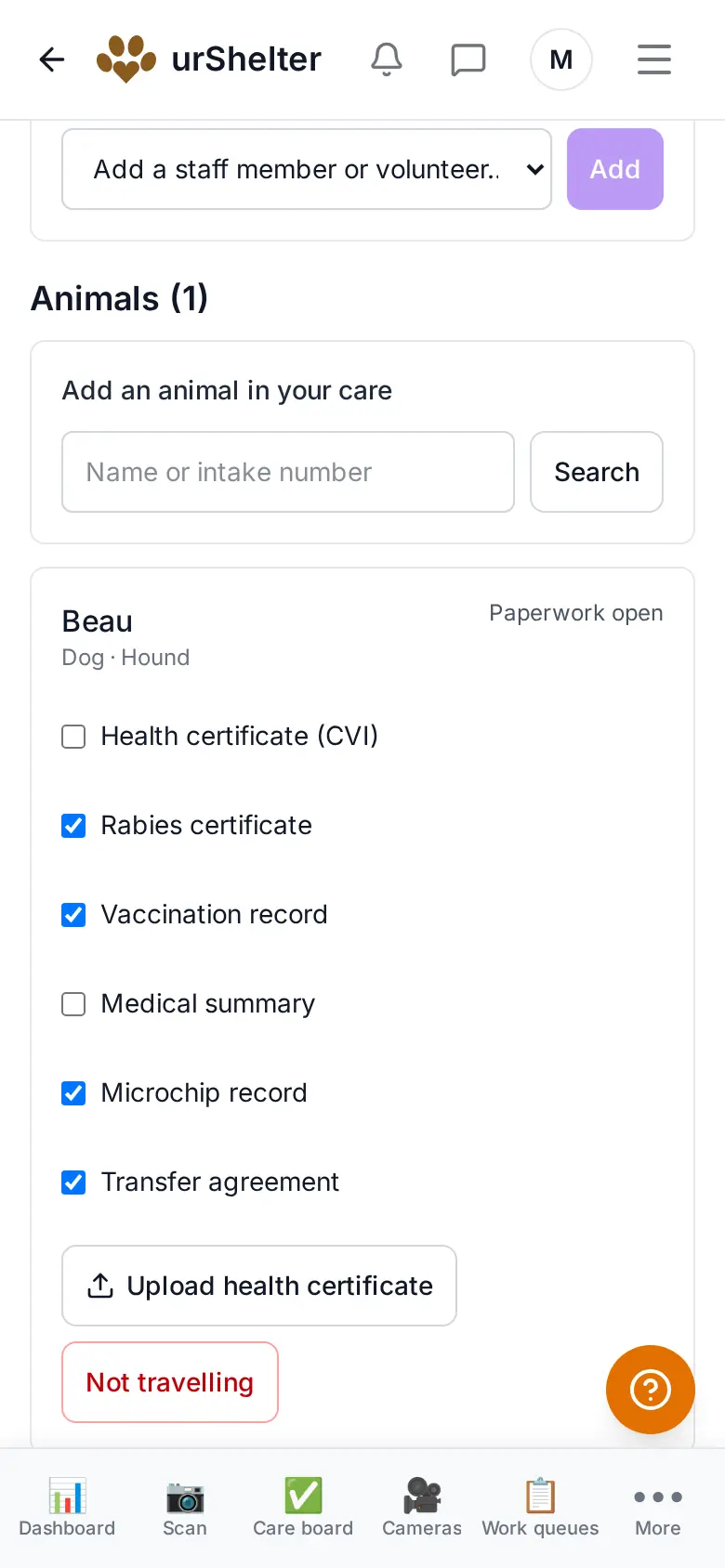
Paperwork checklist for Beau on a transport run, with four of six documents ticked and a health-certificate upload button.
Paperwork per animal: health certificate, rabies, vaccines, microchip, transfer agreement.

Surrender help

A public form for people thinking of surrendering, your local help listed first, and a queue for staff to follow up.
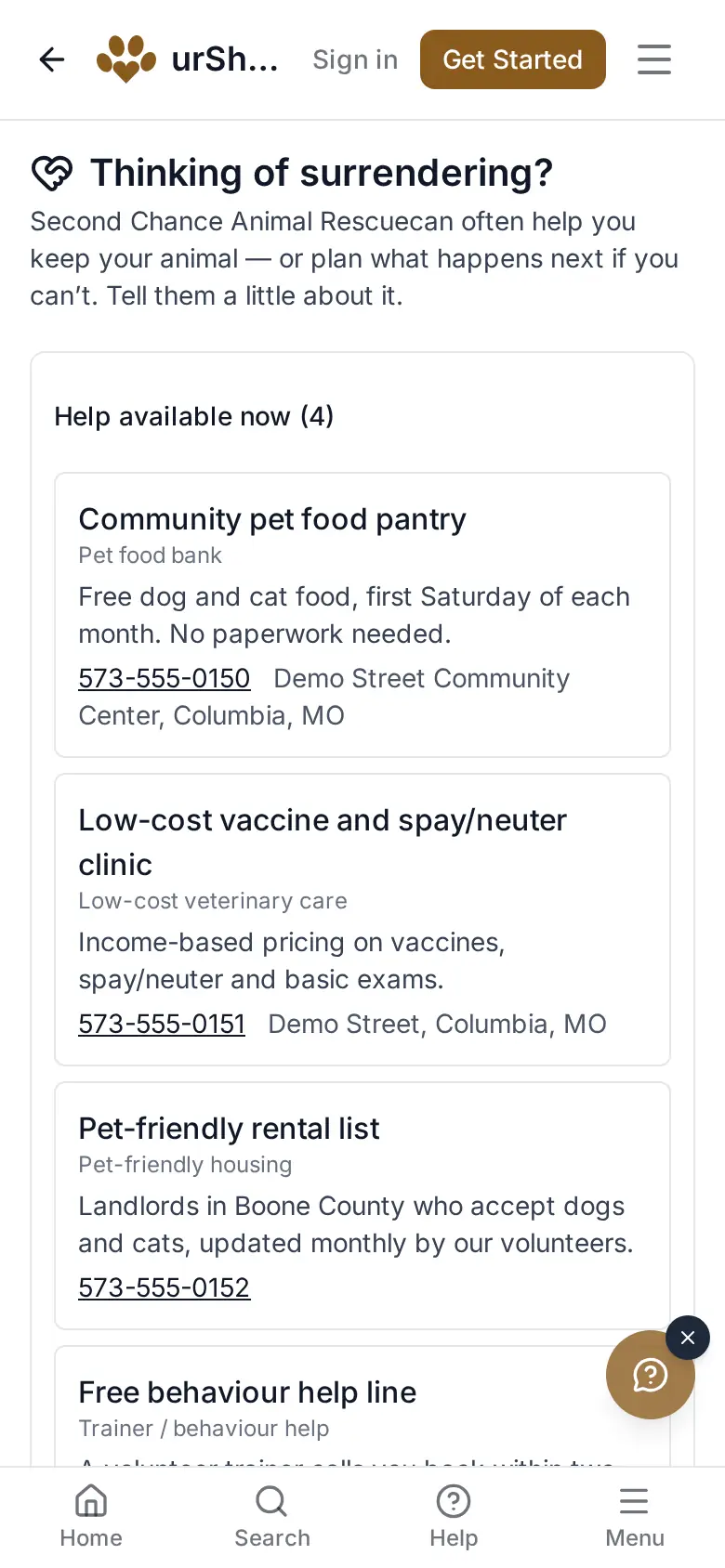
Public surrender help page listing a pet food pantry, a low-cost vaccine clinic and a pet-friendly rental list.
The public form opens with the help your shelter lists.
Public surrender form filled in: cost of care, within a week, a nine-year-old cat named Marigold.
The person says why, how soon, and about the animal.
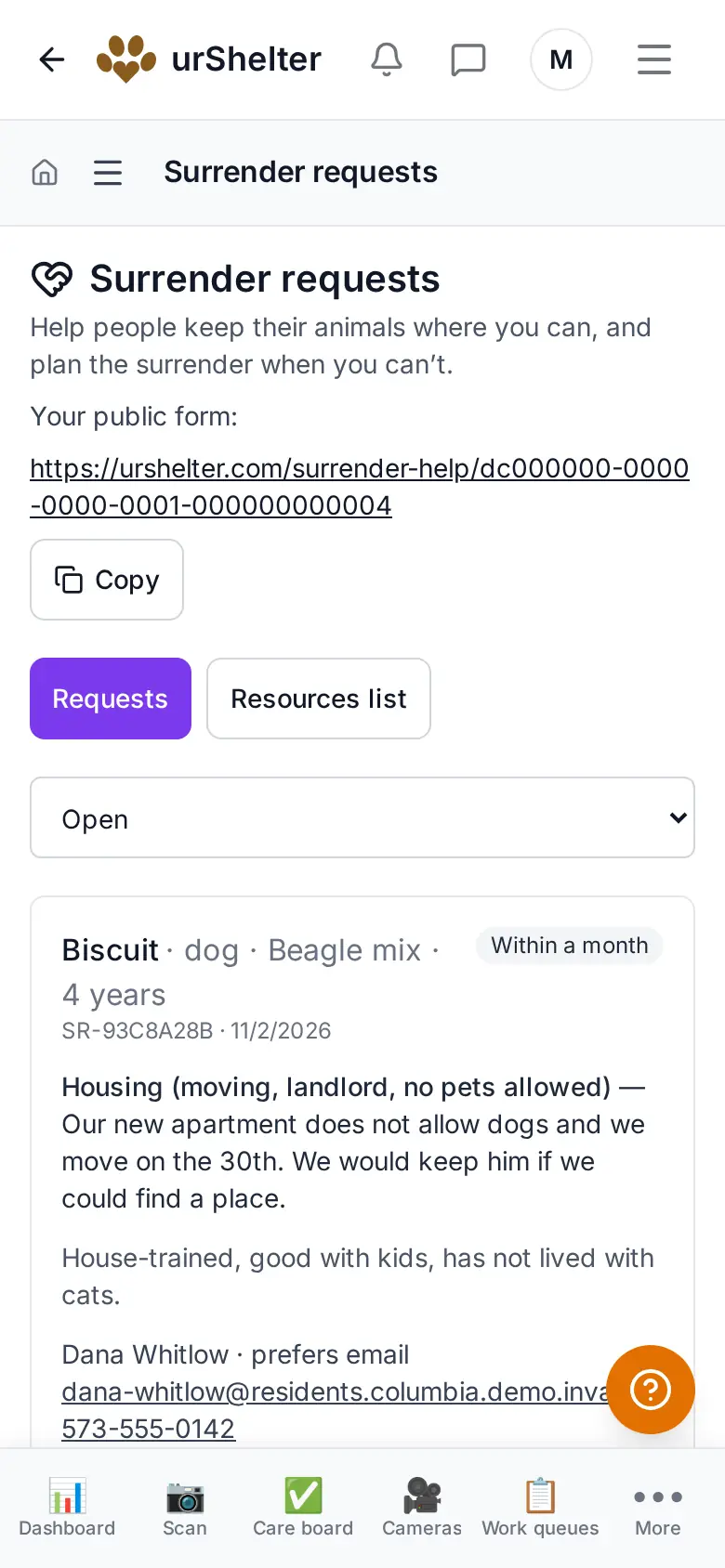
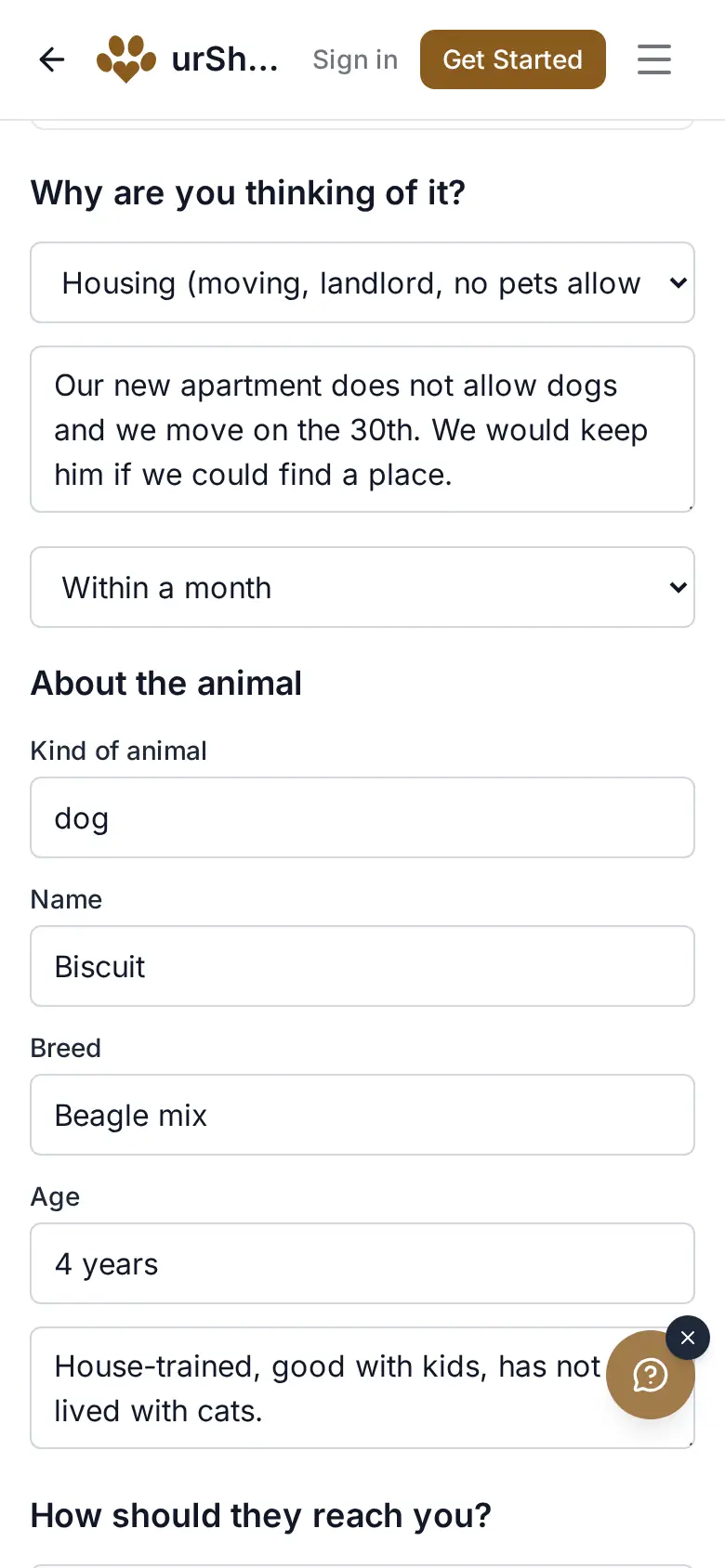
Staff surrender request queue showing a request for Biscuit, a beagle mix, because of housing, within a month.
Staff see each request with its reason, urgency and how to reach the person.

Litters born in care

Record how many were born; each newborn gets its own record with the mother attached and the father recorded as unknown.
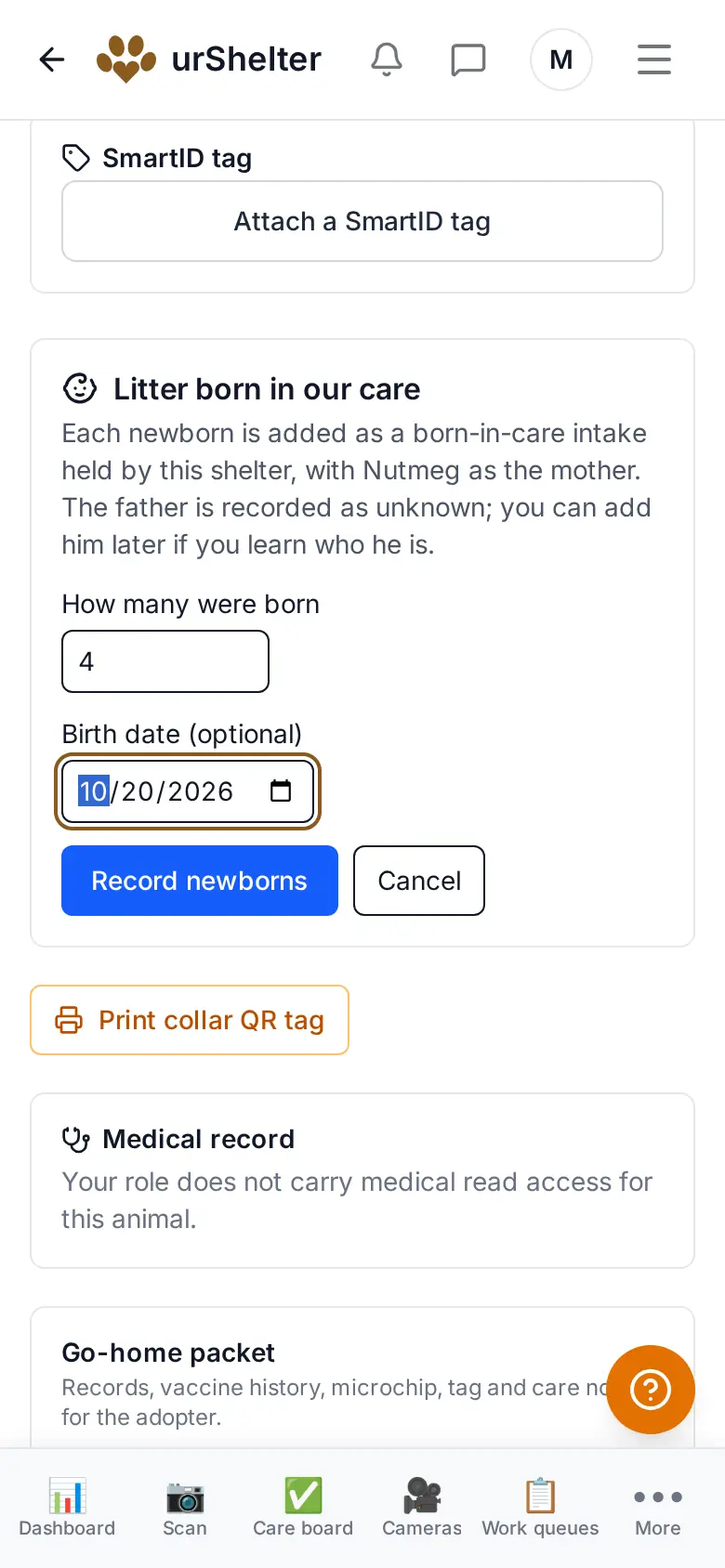
Litter born in our care panel on Nutmeg’s record with four newborns and a birth date of October 20, 2026 entered.
Recording a litter of four on the mother’s record.

Your shelter’s policies

Choose which roles do what. Each choice starts at a default, and every change records who made it and when.
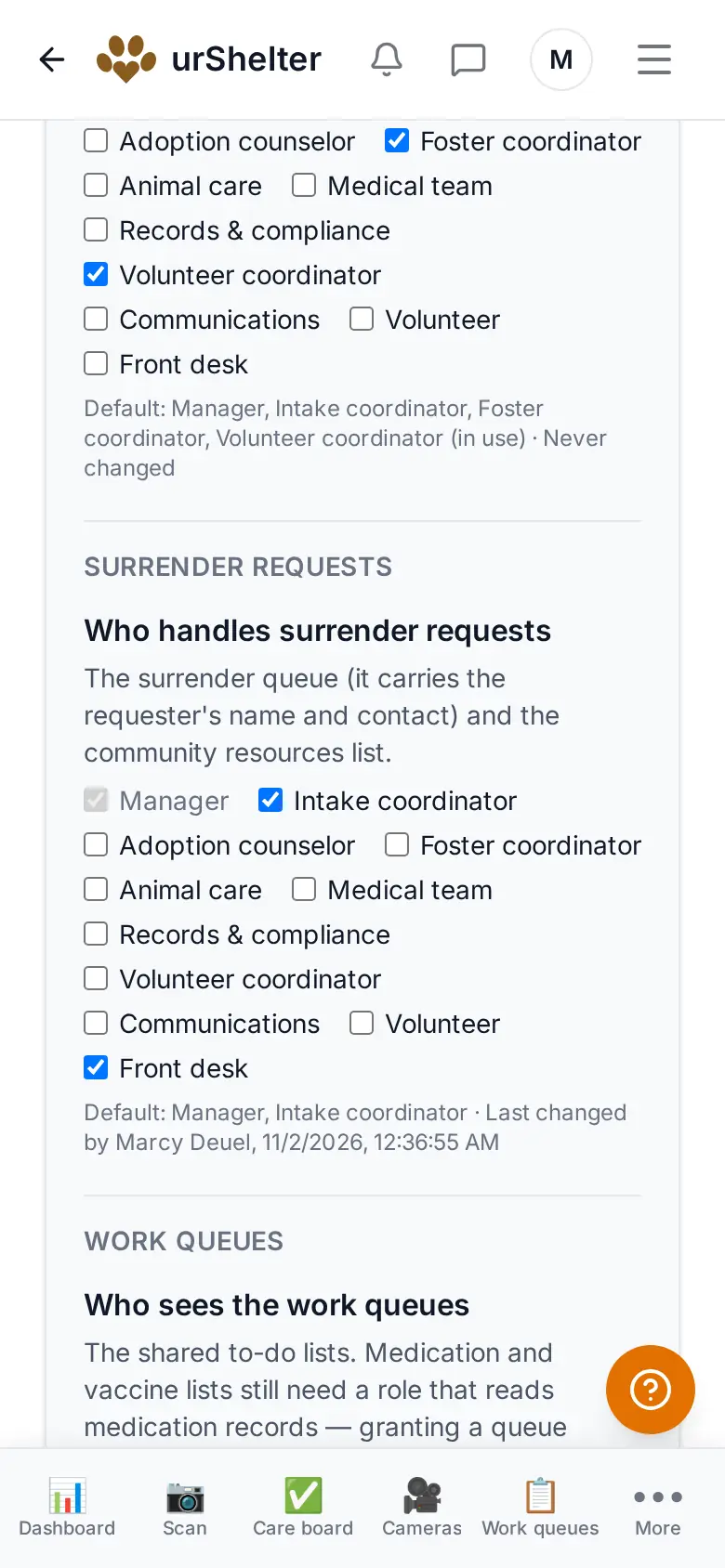
Policies settings: role checkboxes for who manages transport and who handles surrender requests, with the last change recorded.
Who handles surrender requests, changed from the default, with the change recorded.

Export and API access

Download your shelter’s data, or give your own system read-only API access.
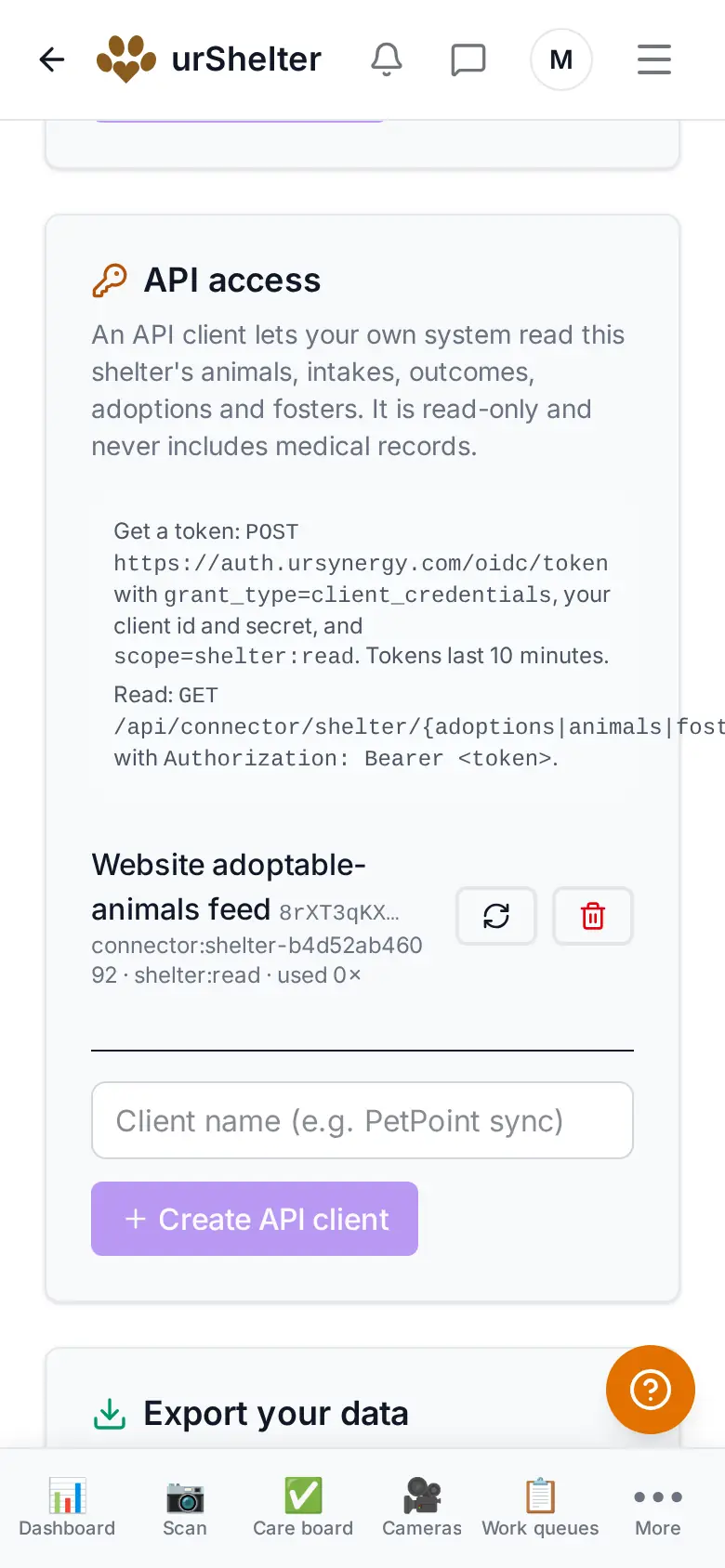
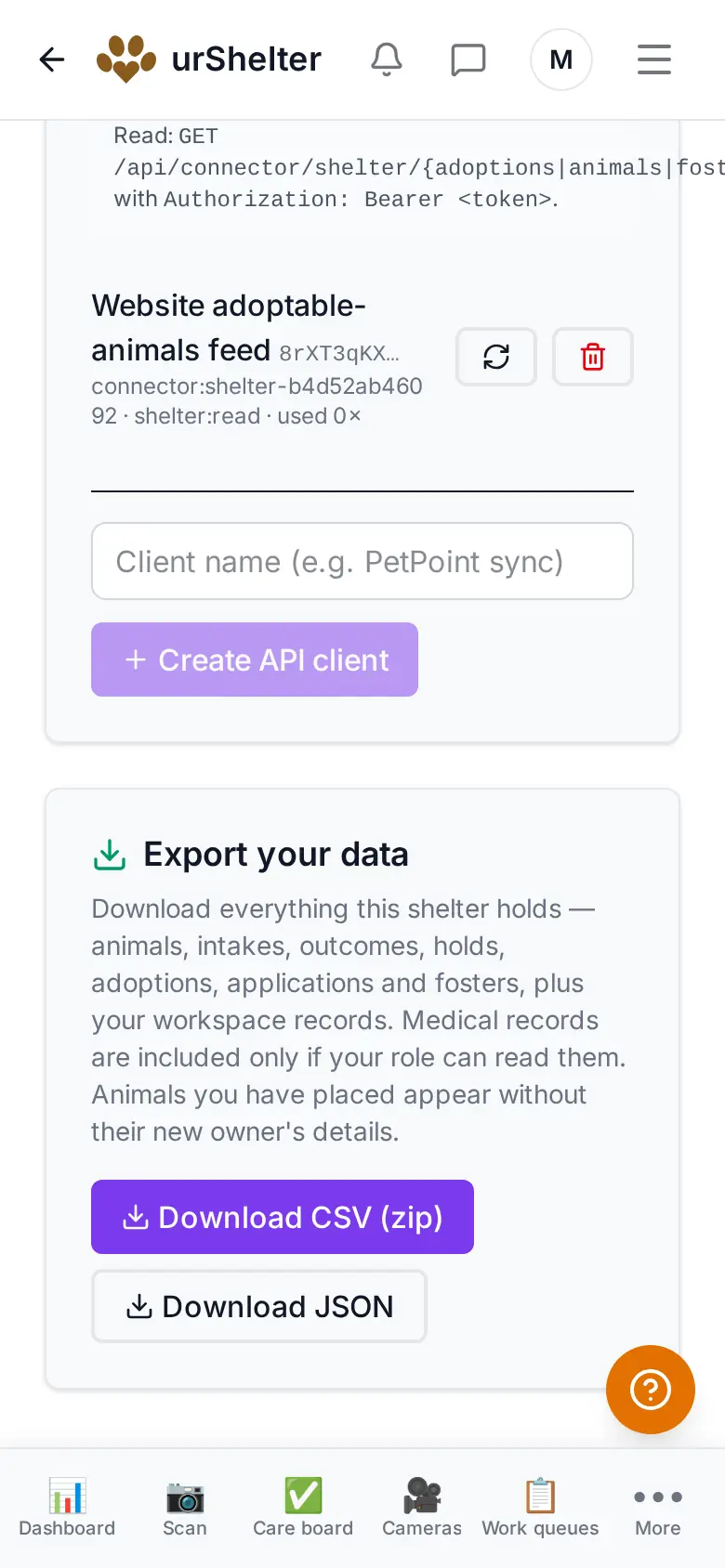
API access settings with a read-only client named Website adoptable-animals feed and buttons to rotate or revoke it.
A read-only API client your shelter creates and can rotate or revoke.
Export your data panel with Download CSV (zip) and Download JSON buttons.
Export as CSV files in a zip, or as JSON.

Adoption workflow

A go-home checklist that includes microchip registration, and other applications for the same animal closed when one adoption completes.
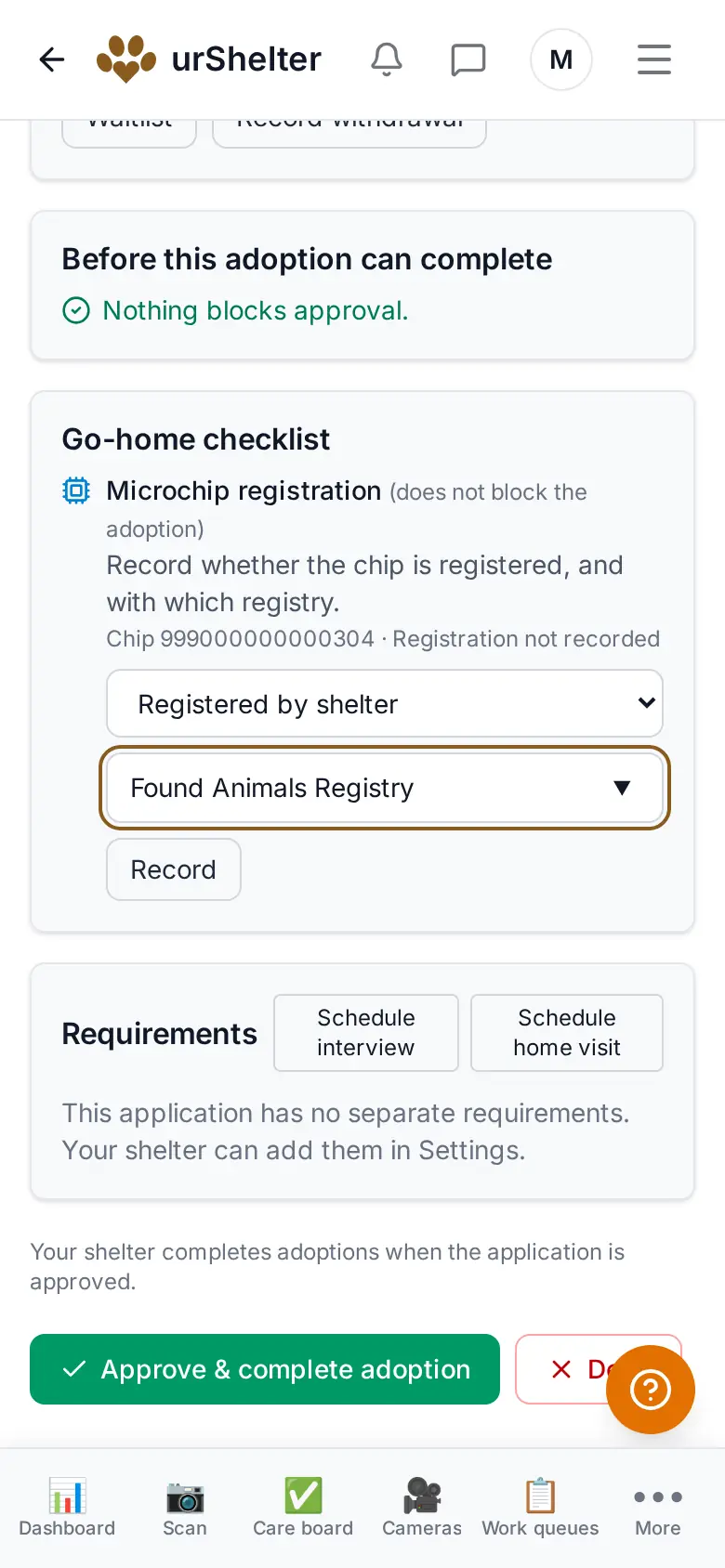
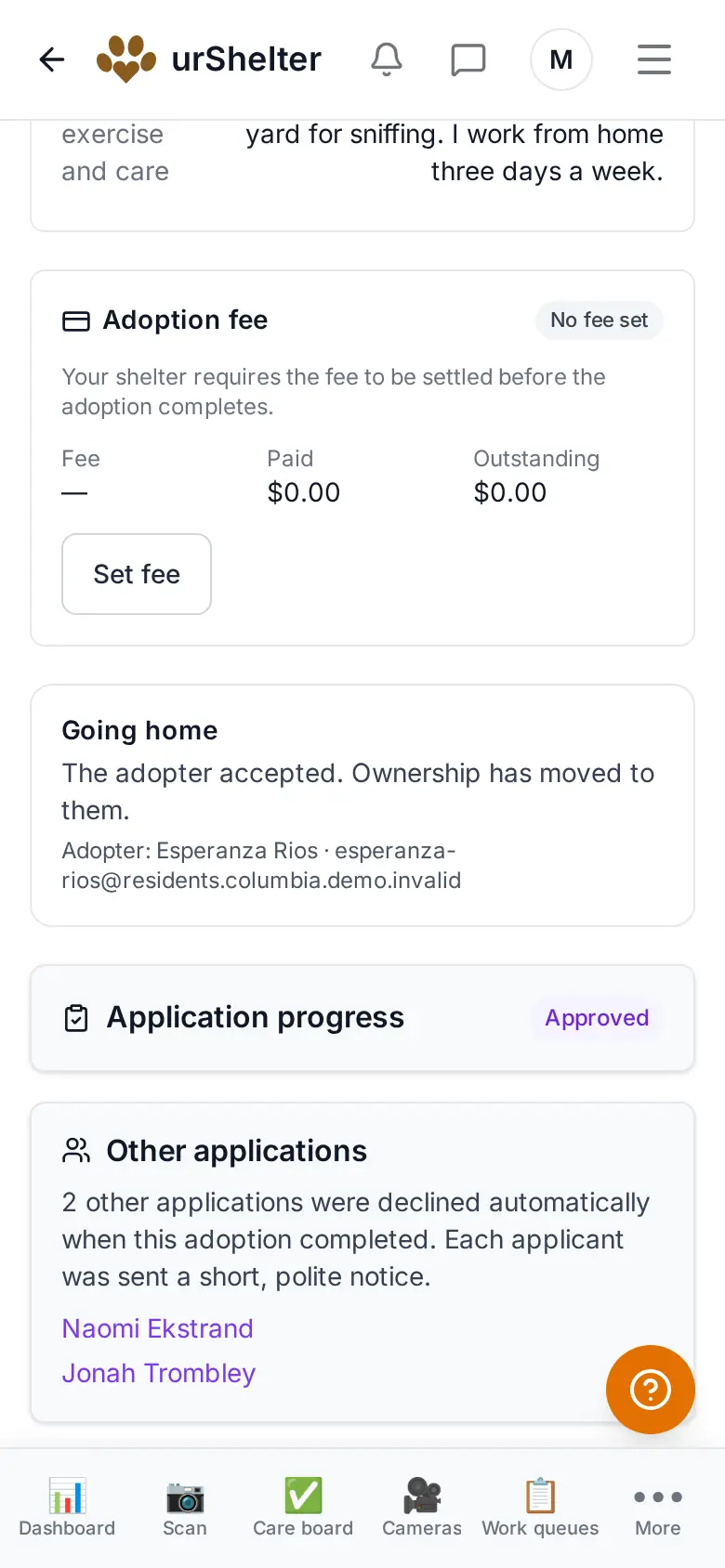
Go-home checklist on an adoption application with the microchip registration step set to Registered by shelter, Found Animals Registry.
Microchip registration: record whether the chip is registered and with which registry.
Approved adoption application showing that two other applications, from Naomi Ekstrand and Jonah Trombley, were declined automatically.
When an adoption completes, the other applications are declined and listed here.

Returns

An adopter can ask to return an animal from their own account; the shelter accepts it as an owner surrender.
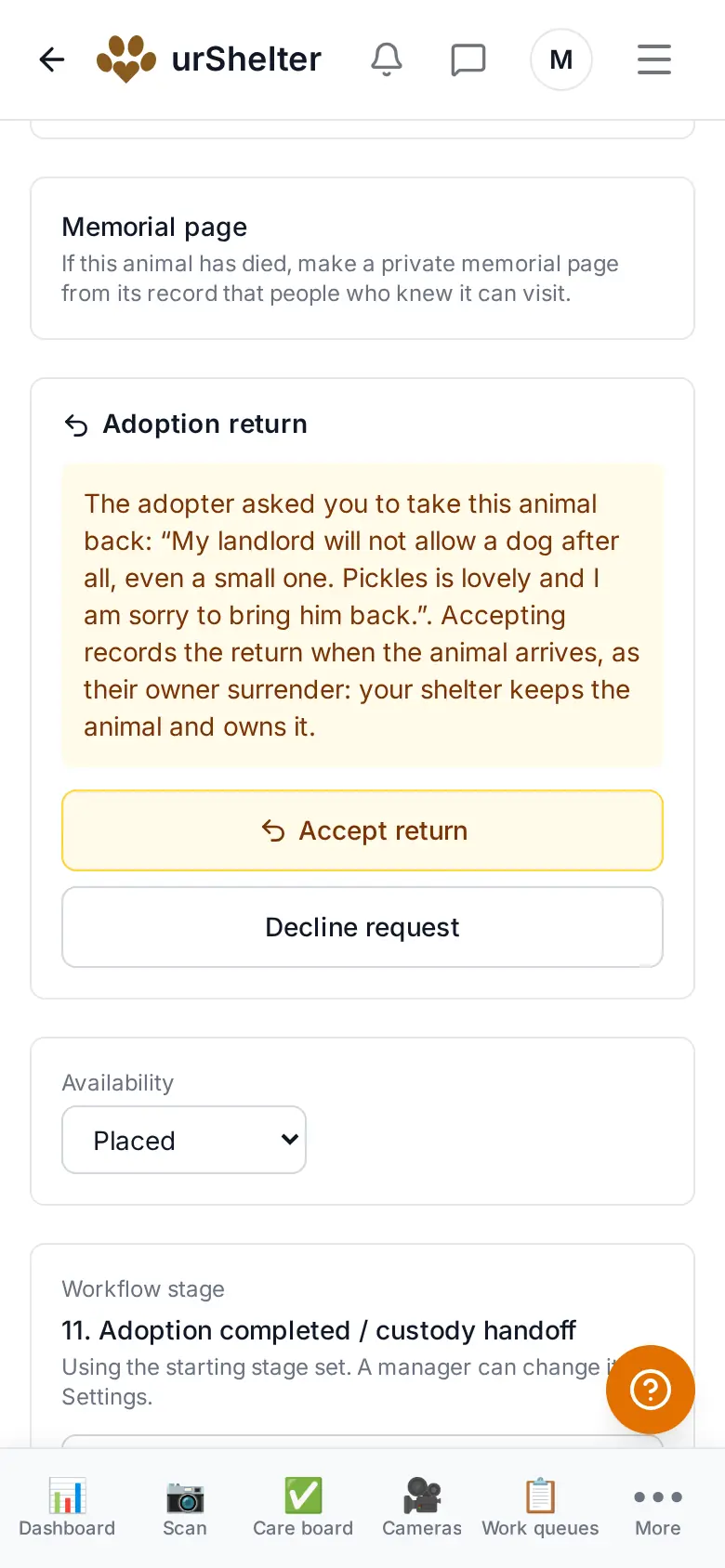
Shelter view of Pickles with the adopter’s return request quoted and Accept return and Decline request buttons.
The shelter sees the request and accepts or declines it.

Personality notes

Staff in every role add notes and traits that stay with the animal wherever it goes next.
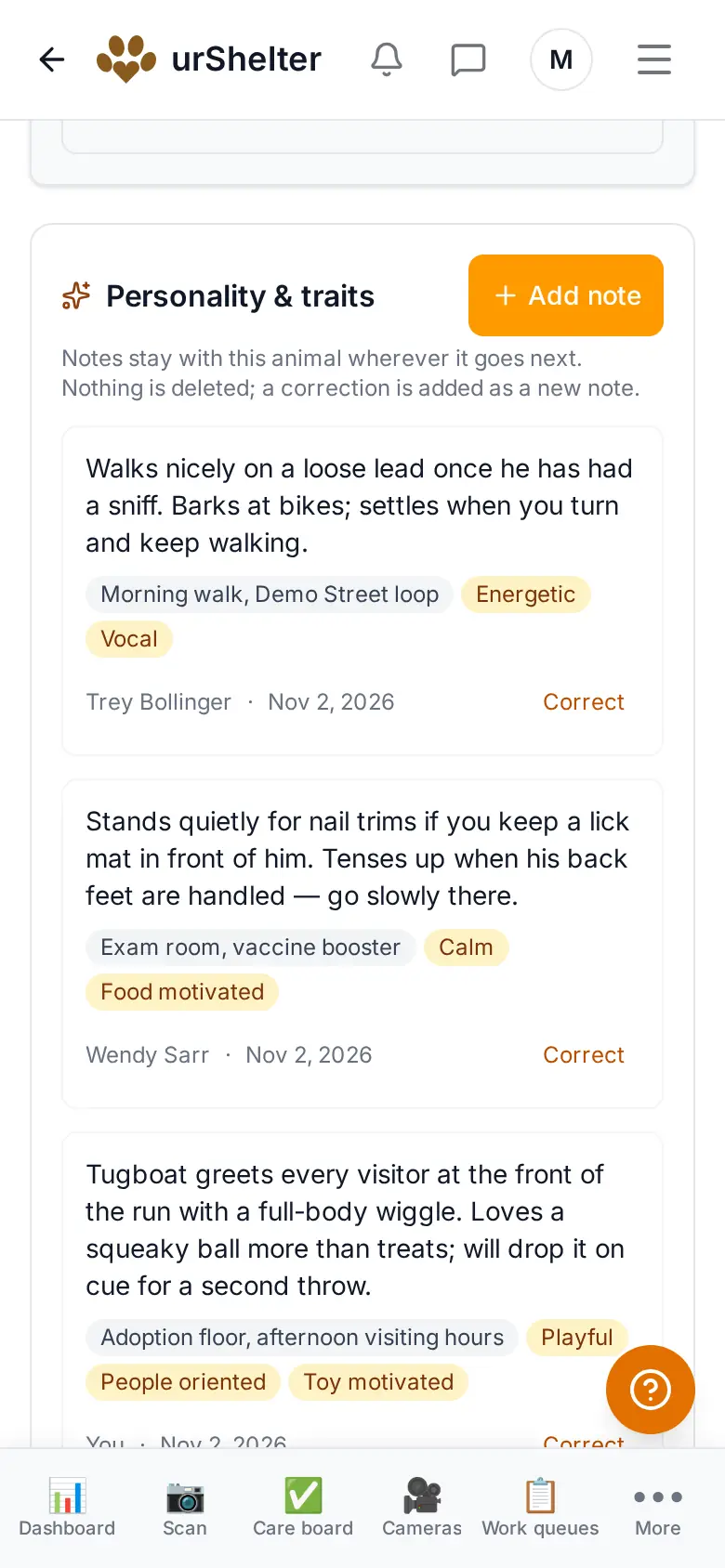
Personality and traits panel for Tugboat with notes from three staff members tagged energetic, calm, food motivated and playful.
Notes from different staff, each with its context and trait tags.

Bulk intake

Take in several animals at once, from a spreadsheet or typed in; check the rows first, then take them in.
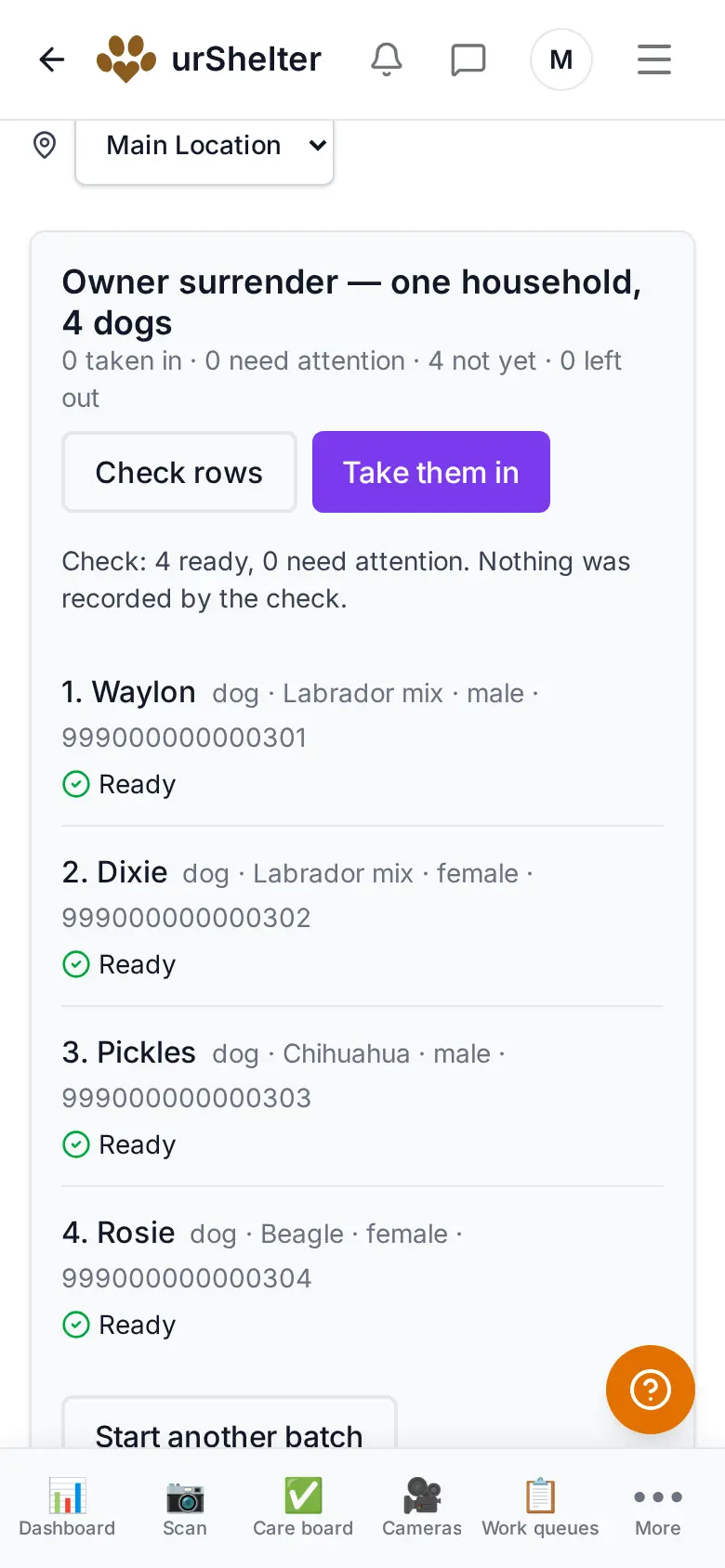
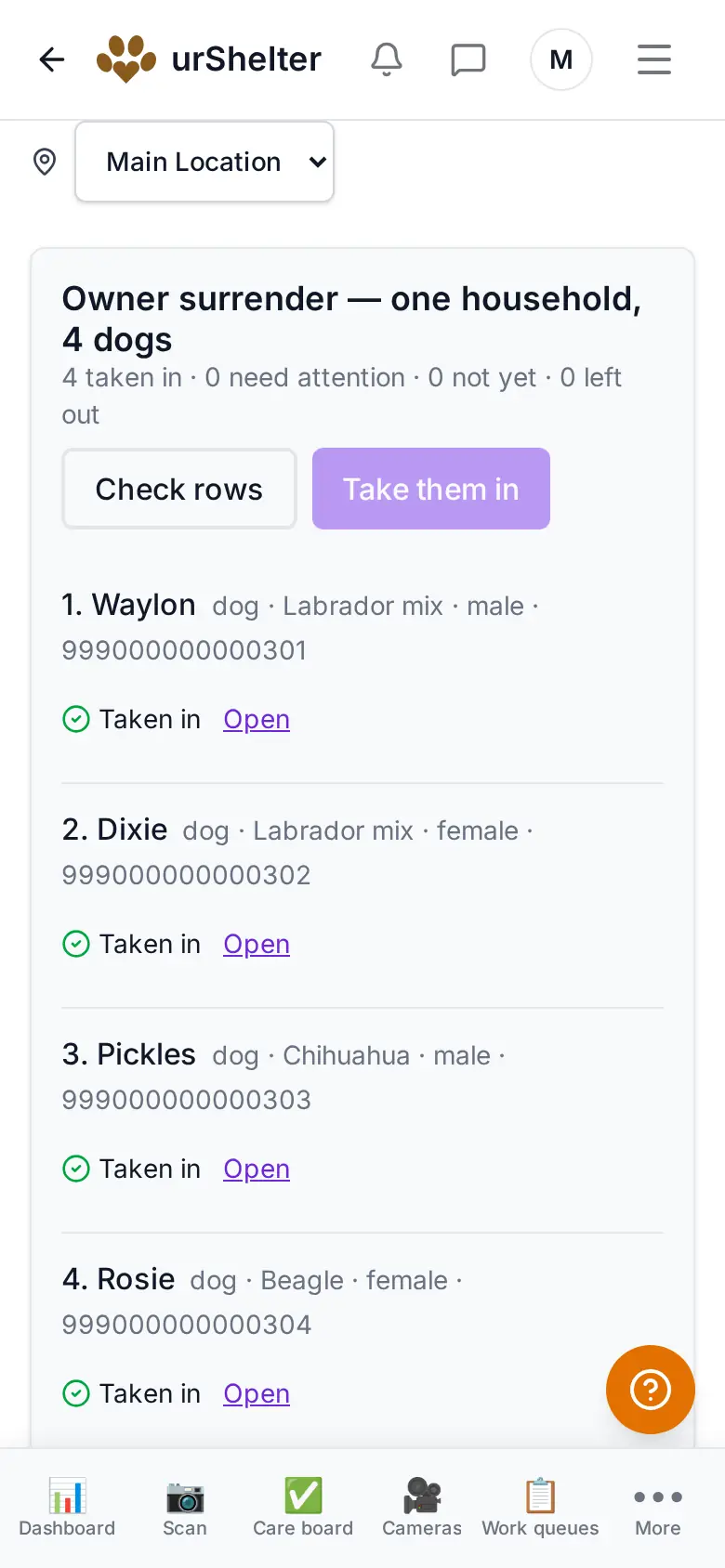
Bulk intake batch of four dogs with every row checked as Ready and nothing recorded yet.
The check reports each row as ready before anything is recorded.
Bulk intake batch of four dogs, Waylon, Dixie, Pickles and Rosie, each marked Taken in with a link to its record.
After taking them in, each animal has its own record.

Listing readiness

Before a listing goes live, it shows exactly what is still missing.
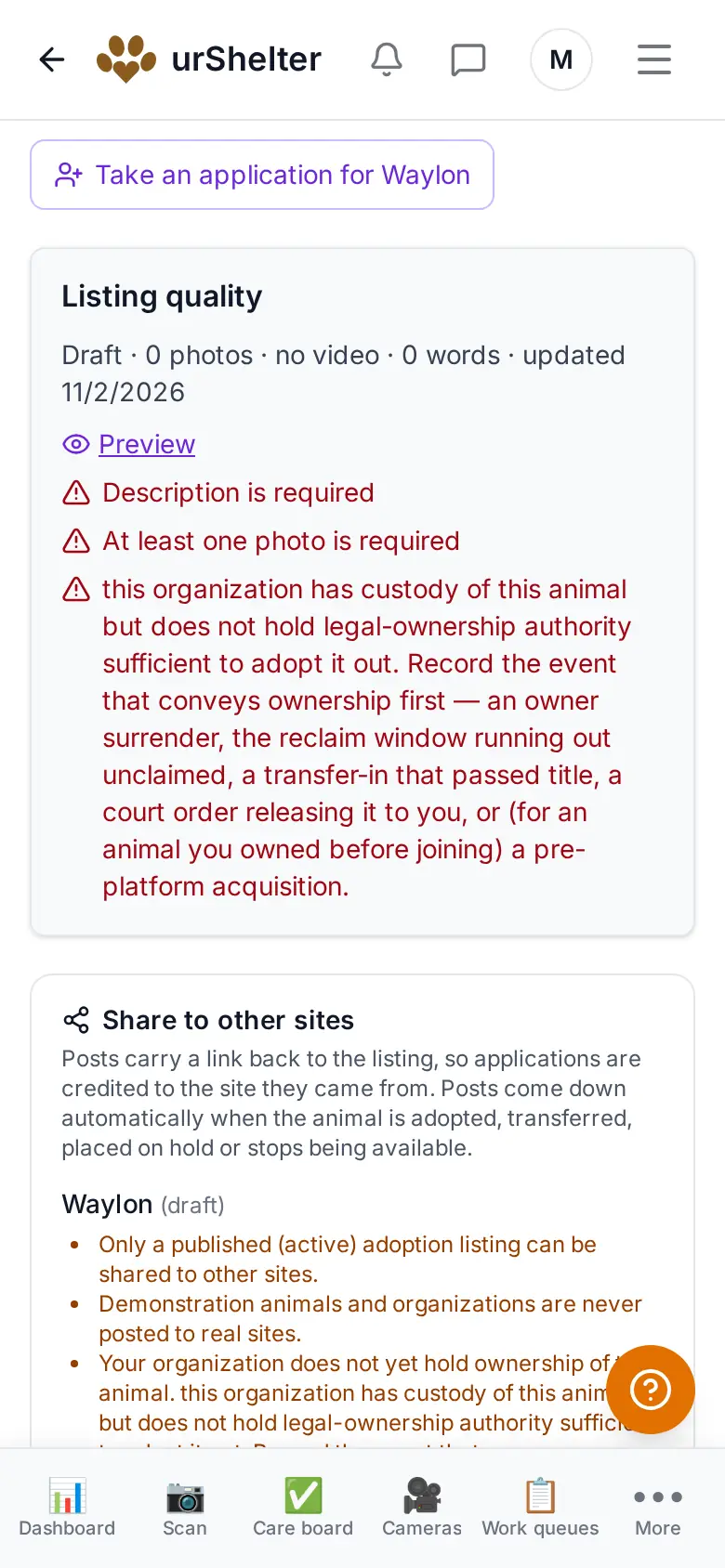
Listing quality panel for Waylon’s draft listing showing that a description, a photo and ownership are still needed.
A draft listing with what blocks it: description, photo and ownership.

Being built now

Named here because it is coming, not because it is ready. Nothing below is in your hands yet.

Scan → act → done

Planned

Print a temporary QR collar tag for an animal whose identity is not yet known, print QR labels for kennels and locations, then move an animal by scanning it and scanning where it is going. Census, custody and history update from the movement itself.

Field and municipal connection

Planned

Stray holds, bite and rabies workflows, and the animal-control side of the relationship you already have with your municipality.

You do not have to replace what you run

Most shelters already have a management system, a vet, a payment processor and a way of doing things. This is designed to sit alongside those, not to demand a migration before it is useful.